A global insight into integration of metro and electric vehicle charging stations

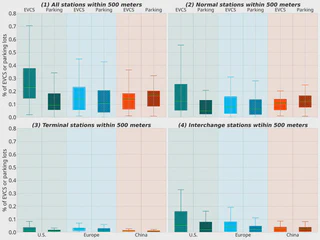 Distribution of EVCS and parking lots by metro station type
Highlights
- A global geodataset of EV charging stations (EVCS) and metro stations is provided.
- The U.S. leads in EVCS aggregation near metro stations, yet development is uneven.
- Europe shows balanced co-development of parking facilities and EVCS.
- China shows strong potential to upgrade park-and-ride to park-charge-ride services.
This study provides one of the first comprehensive, data-driven assessments of the emerging Park-Charge-Ride (PCR) concept across 153 urban areas in the United States, Europe, and China. By analyzing the spatial proximity, density, and clustering patterns of electric vehicle charging stations (EVCS) and parking lots relative to metro stations, we reveal significant regional disparities in the readiness and development of integrated electric mobility hubs:
- Substantial regional contrasts: The United States shows strong but uneven aggregation of EVCS near metro stations; Europe achieves a more balanced integration of EVCS and parking facilities; while China, despite its extensive metro networks, exhibits limited EVCS integration near transit nodes.
- No significant link to station type: The distribution of EVCS does not significantly align with metro station types (normal, interchange, or terminal), indicating a missed opportunity for targeted infrastructure planning.
- Divergence between PCR and P&R development: The U.S. shows stronger development of PCR relative to traditional Park-and-Ride (P&R), whereas China has strong P&R presence but significant potential to upgrade to PCR. Europe maintains parity between the two.
The research underscores that integrating EV charging with transit systems is highly context-dependent and should align strategically with local urban development goals. It provides evidence-based insights to help policymakers, transport planners, and urban developers optimize charging infrastructure placement, enhance multimodal connectivity, and support the global shift toward sustainable electric mobility.
