Dynamic Social Disparities in the U.S. Electric Vehicle Charging Infrastructure System
3月 3, 2026·, ,,·
1 分钟阅读时长
,,·
1 分钟阅读时长
马瑞晨
Mingming Guan
滕定康
杨雄
诸葛承祥
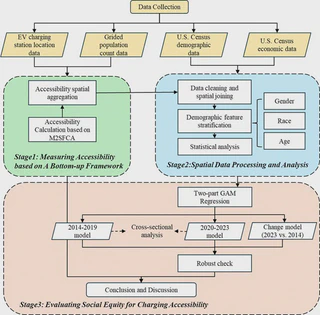 Analytical framework
摘要
Equitable access to public electric vehicle (EV) chargers is crucial for reducing barriers and promoting adoption. Although recent studies have examined social disparities of charging accessibility in the United States, they usually focus on a single year, with long-term trends remaining unclear. This study proposes a novel framework to examine long-term changes in social disparities in access to EV chargers by charger type, gender, race, and age, using two-part generalized additive models and nationwide data from 2014 to 2023. Our results indicate that charger access tends to be higher in counties with above-median household income, larger populations, and greater shares of multi-unit dwellings. Counties with higher proportions of males, Asian, Black Americans, and younger adults generally experience lower charging accessibility. After 2020, Asian Americans saw improved accessibility, while Black Americans still faced widening disparities. These findings underscore the need for equitable strategies to reduce long-term charging inequities.
类型
出版物
Transportation Research Part D: Transport and Environment
提示
Highlights
- Charger deployment favored wealthier and more populated counties with high MUD shares.
- Social equity is dynamic rather than static.
- Asians saw improved accessibility, while Black Americans faced widening disparities.
- White Americans benefit more from DC over the past decade.
- Elderly have greater access to both DC and AC chargers than younger adults.
